Uniquely situated at the crossroads of America, Texas is a melting pot of divergent cultures and traditions. Covering an expansive area of 268,596 square miles, the Lone Star State is the second largest in the United States[^1^]. From the bustling urban landscapes of Houston and Dallas to the desolate plains in West Texas, the state proves to be a diverse cultural tapestry with a rich historic past. This article delves into the birth of the Lone Star State, its economic prowess, culture, iconic landscapes, and more.
Land of Contrasts: Geography and Climate
Texas is a land of contrasts with its geography encompassing forests, deserts, swamps and 367 miles of coastline along the Gulf of Mexico[^1^]. The state is divided into several regions: East Texas with its dense piney woods, the barren desert and rugged mountains of West Texas, the fertile prairies of the Panhandle, the scenic Hill Country and the flat coastal plains.
The state’s climate is as diverse as its landscape, with a wide range of temperature fluctuations from the humid subtropical climate in eastern Texas, to the semi-arid climate in the western and central regions. Texas has also been known to be afflicted by floods, tornadoes, hurricanes, and droughts.
Historical Overview: The Birth of the Lone Star State
Texas has a rich and storied history that has helped shape the state’s identity. The state was first colonized by the Spanish and later became part of Mexico after the Mexican War of Independence. It was in 1836 after the Texas Revolution that Texas won its independence and became the Republic of Texas[^2^]. Nine years later, it joined the United States as the 28th state.
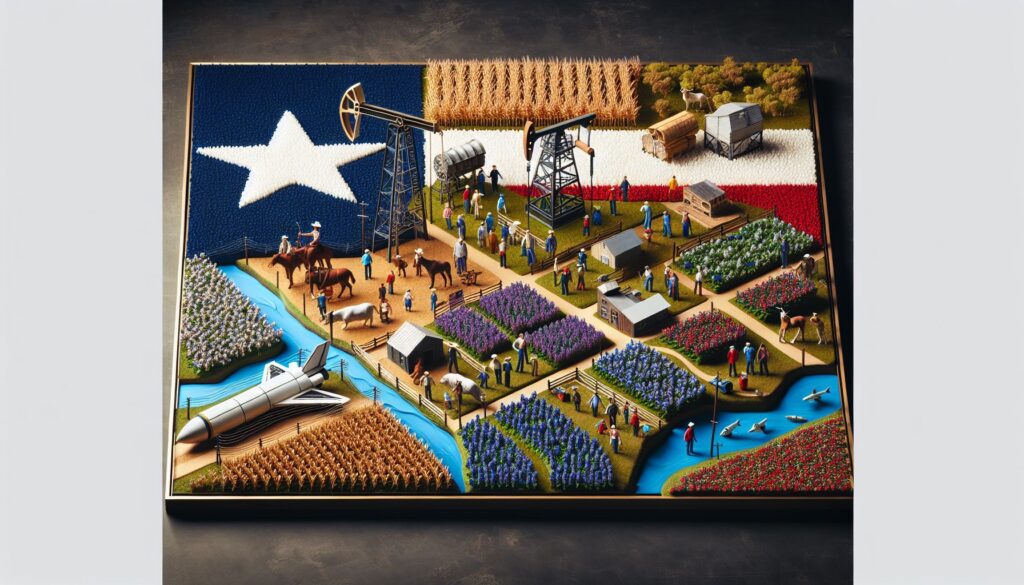
The Lone Star State gets its name from the solitary star featured on the 1836 flag of the Republic of Texas, symbolizing Texas as an independent entity. The moniker became an official part of the state’s identity when it was adopted by the Texas Legislature in 1845.
The Lone Star Economy: A Cornucopia of Resources
The uniqueness of Texas is also reflected in its diverse economy, which has been ranked the 10th largest globally if it were a standalone nation[^3^]. It encompasses sectors like agriculture, petrochemicals, energy, computers and electronics, aerospace, and biomedical sciences.
Texas leads the nation in cattle, cotton, and oil, and is a major player in natural gas productions. The state boasts many Fortune 500 companies and has a robust and growing job market. The tech scene is burgeoning, particularly in Austin, christened as “Silicon Hills”, owing to the proliferation of tech companies.
The Cultural Melting Pot
Texas showcases a plethora of cultural influences from Native American, Mexican, German, and Czech to name a few. Literature, music, sports – mainly football -, and cuisine are a significant part of its culture.
Tex-Mex cuisine, a blend of American and Mexican culinary traditions, originated within the Tejano community in Texas. The state is also famous for its BBQ with different regions having their unique styles. Texas German, a dialect spoken by German immigrants, is still spoken today though by a rapidly dwindling population.
The Texas Experience
Rich in scenic beauty and diverse landscapes, Texas offers countless tourism opportunities. You can take in the historic landmarks at the San Antonio Missions National Historic Park or explore the rugged beauty of the Big Bend National Park[^1^]. View the world’s most extensive spaceflight collection at Space Center Houston or cheer on cowboys at the iconic Texas rodeo.
The state’s sprawling cities like Houston, San Antonio, Austin, and Dallas are full of attractions – art galleries, museums, music festivals, and sporting events. These metropolitan cities play host to several internationally renowned events like Austin’s SXSW and Austin City Limits, and the Houston Livestock Show and Rodeo.
Texas embodies the American spirit of independence and personal liberty. Its culture, economy, and landscapes are as extensive as the state itself, offering endless opportunities and experiences. As the saying goes, “Everything’s bigger in Texas” and the Lone Star State does indeed wear its size and heritage proudly.
[^1^]: “Texas Fast Facts and Key Resources”. World Population Review. https://worldpopulationreview.com/states/texas-population/.
[^2^]: “Texas History”. History.com. https://www.history.com/topics/us-states/texas.
[^3^]: “Assessing Texas Economy against the World”. Investopedia. https://www.investopedia.com/articles/investing/010616/if-texas-were-nation-its-economy-would-be-10th-largest.asp.