Alaska, geographically positioned in the extreme northwest part of the North American continent, is the largest U.S. state by area, and one of the most sparsely populated. Today, we take a deep dive into Alaska, exploring its geography, culture, history, and economy.
Geography
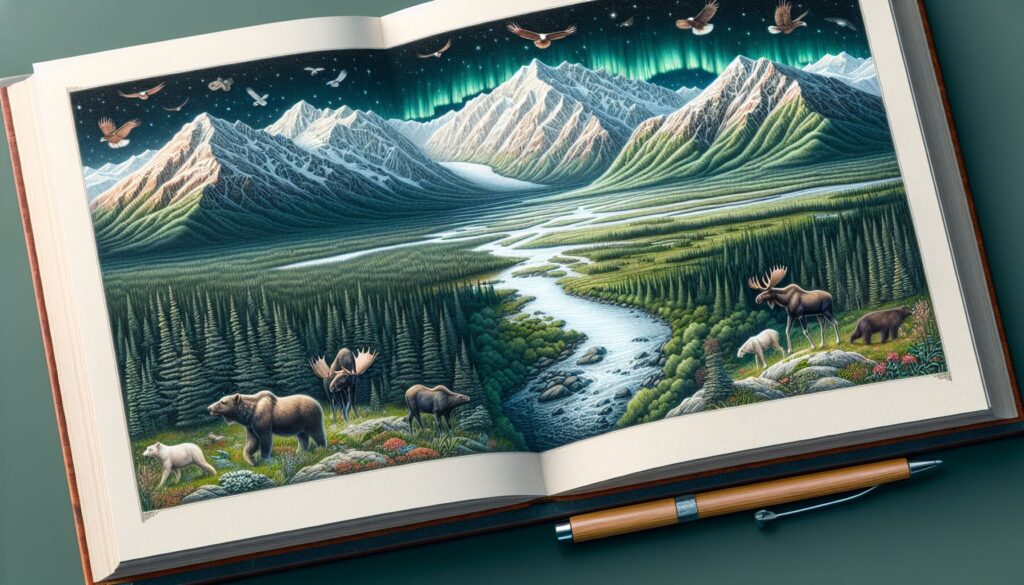
Alaska boasts a rich tapestry of topography, climate, and ecosystems. Dotted with numerous mountain peaks, deep forests, and stunning coastlines, Alaska teems with unique flora and fauna¹. Wrapped in crystalline glaciers, the towering Mount McKinley in Denali National Park is the highest peak in North America.
Alaska has three distinct coastal lines: the Arctic Ocean shoreline, the Bering Sea coastline, and the Pacific Ocean coastline. These waters are abundant with marine life, including seals, walruses, whales, and a variety of fish.
The Interior Alaska region is typified by its boreal forests teeming with spruce, aspen, and poplar trees. It is also home to several species, like the grizzly bear, Canadian lynx, and caribou.
The Arctic Alaska, with its permafrost tundra, is an ecological wonder, sustaining hardy mammals like muskoxen, Arctic foxes, and polar bears despite the harsh environment.
Culture
From indigenous tribes to contemporary society, the cultural landscape of Alaska remains as diverse as its physical geography. About 15% of Alaskans are indigenous peoples, the highest proportion in the U.S².
The cultural heritage of Alaska extends to a variety of dances, music, art, and native languages. Traditional Alaska Native dance remains a vibrant part of many Alaskan communities. The folk and traditional music revolve around themes of hunting, the sea, and love for nature.
Alaska’s native arts and crafts, be it the Tlingit totem poles, Yup’ik masks, or Aleut baleen baskets, are immensely cherished. Some indigenous Alaskan languages like Alutiiq, Koyukon, and Yup’ik are still spoken today, alongside English.
History
Alaska’s history features an intriguing tapestry of indigenous cultures, Russian colonization, gold rushes, and American statehood. Anthropologists estimate that Alaska was populated by Native Americans as early as 14,000 years ago³.
By the late 1700s, European explorations led to Russian colonization. However, weakened by war and financial trouble, Russia made the decision to sell Alaska to the U.S., a transaction known as “Seward’s Folly.” Later events proved this to be a strategic purchase, as the Klondike Gold Rush of 1896 ushered an era of prosperity.
Alaska achieved U.S. statehood in 1959, but only after World War II and the discovery of oil boosted its strategic and economic importance.
Economy
In the past, Alaska’s economy was mainly driven by fishing, timber, and mining, but today, the petroleum industry is the largest contributor to the state’s economy. The Prudhoe Bay on Alaska’s North Slope is the highest-yielding oil field in the United States.
The Federal Government is a major employer in Alaska, helping maintain the state’s economy. Tourism contributes significantly to Alaska’s coffers, too, attracting those eager to experience its wilderness, wildlife, and Native American culture.
Alaska is a crucible of beauty and diversity, a place where adventure meets tranquility, where cultural roots seize global influences, and where the spirit of nature redefines the spirit of America. Its captivating landscapes beckon explorers, and its historical narrative fascinates every visitor.
Like Jack London’s portrayal in “The Call of the Wild,” Alaska remains a land of opportunities and exploration, continually asserting its unique space in the world’s consciousness.
Sources
– 1. “Alaska Region.” U.S. Forest Service. https://www.fs.usda.gov/detail/r10/home/?cid=fsbdev2_038379
– 2. “Why is the native population in Alaska so high?” KNOM Radio Mission. https://www.knom.org/wp/blog/2013/04/01/why-is-the-native-population-in-alaska-so-high/
– 3. “The First Americans: New Discoveries Shift Timeline Back by 25000 Years.” Smithsonian Magazine. https://www.smithsonianmag.com/smart-news/humans-arrived-americas-25000-years-earlier-previously-thought-180962877/